 |The Man|Jolson, Blackface and Racism|Will Marian Cook on Jolson
|The Man|Jolson, Blackface and Racism|Will Marian Cook on Jolson
|The Man|Jolson, Blackface and Racism|Will Marian Cook on Jolson

LEW DOCKSTADER, a monologist and comedian of the highest rank, very similar in appearance to Theodore Roosevelt, came to the Gotham Attucks Music Company on West Thirty-Seventh Street, to carry me over to the Majestic Theatre in Brooklyn. The Gotham Attucks was a colored music publishing firm. which had great songs but little money with which to push them.
I should therefore have welcomed this opportunity to place two of the firm's songs — "Down Among the Sugar Cane," by Cecil Mack and Chris Smith, and "Red, Red Rose," by Alex Rogers and me — in Lew Dockstader's minstrel show. But I was ill. George Walker, of Williams and Walker, and my best pal, was insane and at death's door, so I didn't care about anything or anybody.
A Real Surprise
This I told Dockstader. His answer was to pick me up bodily. put me in a cab. and drive me over to the Majestic, where I was to rehearse the voices after the matinee. Alas! The two songs, whose placing in the show would have meant thousands of dollars to our tottering firm, never even got to rehearsal.
As I got out of the cab and started for the stage door, Dockstader took my arm, directed me to the front of the theatre, and forcibly sat me down in the last row of the orchestra, saying: "Sit there; I've got a real surprise for you!"
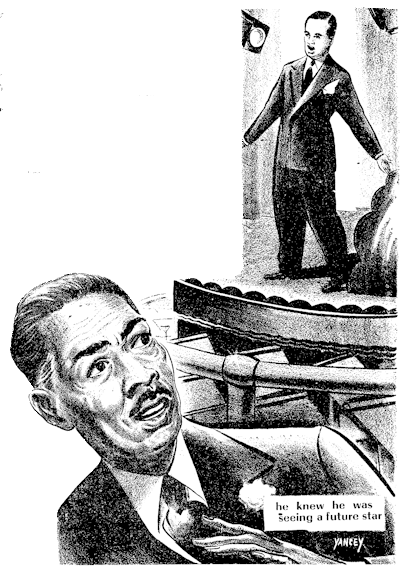 He left. I started to get up when a boy in
blackface appeared on the stage. He was
electrical even before opening his mouth.
He left. I started to get up when a boy in
blackface appeared on the stage. He was
electrical even before opening his mouth.
A little below medium size, eyes like moons, not stars, a speaking voice partly Jewish, partly Negroid. Maybe Jews and colored are akin. They share everything equally; that is, they get all the money; we get all the blab. So, after all, they go 50-50 with us.
I sat down again, then, when he began to sing, I had to stand up once more. I couldn't keep still, I was magnetized, held spellbound. I walked up and down back of the orchestra rail and, as his act drew to a close, I rushed back stage through the boxes, out of breath, almost hysterical.
As I stood looking about stage for Dockstader or anyone from whom to inquire the artist's name, a boy, perspiration streaming down his face, walked out of the wings, came up to me and said, "I know you; you're Will Marion Cook. I used to demonstrate your 'On Emancipation Day' and other songs in the New York music stores when I was a boy so- soprano."
What I had just heard was a rich, vibrant baritone, Jewish Cantor-like, an untrained Scotti, a voice filled with Negro fervor, a voice to make millions get happy. "I'm Al Jolson," he added.
Wonder of wonders! Here was a Jew. the most talented entertainer of his time, out with a minstrel show, not on Broadway, where his race owned everything. including the theatrical air the actors must breathe!
"Boy, why aren't you on Broadway?“ I asked.
Where sweat had streamed down his face before. now the tears came, real tears, an avalanche of them. "I can't get in anybody's office. Can't even talk to the office boys." he answered. Then he added proudly (no more tears) "Out on the Coast I'm a knockout!"
In the meantime, the Brooklyn audience was still storming for more encores, though he had already given four or five. Simply saying, "I'll see that you get on Broadway right now,' I rushed out the stage entrance, forgetting about Dockstader, our songs, everything but that wonderful boy.
I grabbed the first cab I saw. and made it in nothing hack to New York and Hammerstein's Theatre. Willie Hammerstein stood outside, puffing as usual on a big black cigar. lie didn't speak as I dashed past him to get to George Archer, my pal for many years, (Archer was a colored man with lots of connections on Broadway). I rushed up to him, and began my rave, a few feet from Hammerstein.
In five seconds, the latter touched me on the arm. "What are you raving about now, Cook?"
"I just saw a boy. The first time he sings a song on Broadway, he'll stop most of the other singers just like that, snap! snap!"
"What's his name?" asked Hammerstein, a little more friendly.
"Al Jolson," said I.
Hammerstein started to walk away, commenting, "I know, he's all right but not for me. He's down at the American Theatre for Will Morris now."
I grabbed his arm. I was too excited to be a gentleman even with Hammerstein who had done so much for colored talent.
"Don't be a damn fool, Mr. Hammerstein! That's Harry Jolson. Al's brother, you're talking about. Al is with Dockstader, over at the Majestic. He's a cyclone. an avalanche. an earthquake, of joy! And you'd better hustle, 'cause right now on I'm on my way to tell Lee Shubert about him."
That was how Jolson got to Hammerstein's Theatre first, after his contract with Dockstader ran out. Later on, at Shubert's Winter Garden, he came. saw, and conquered all the world that visited New York_ And Al is still going strong.
(Editor's Note: At Jolson died last month.)
Never a great comedian. and the velvet has gone from his voice, still he has great dramatic talent, a great soul, and a sure clutch on the heartstrings of one hundred million people. There'll never be another Al Jolson!
I'm colored, and people sometimes don't like to admit that a colored man could do what they had either not tried or failed in trying to do. Lee Shubert, very proudly, may not want to remember that the man who first told him of Al Jolson did not even get a good cigar in return.
But if anyone denies this story, there's plenty of proof, maybe an eye-witness to the Hammerstein scene and several others still alive and going strong.
Jolson may not know of this incident. He has never mentioned it to me. All I know is: he has helped thousands of colored persons, While he was at the Winter Carden, and even later, he went to bat for any protege I sent him or asked him to boost.
|
Updatged 14 Jun 26 |